Why Pests Become "Immortal": The Problem of Resistance to Household Pest Control Products
Why do cockroach and ant sprays stop working? We examine the phenomenon of resistance, the mistakes we make, and why professional intervention is often the only solution.

Pest Control Manager at "Biogard" EOOD
- Published on
- min. read
- 7 min. read
Table of Contents
Has this ever happened to you: you buy an expensive cockroach or ant spray from the supermarket, enthusiastically spray the kitchen, and the initial effect is "wow" - the pests disappear. A month later, they're back. You buy the same spray, spray again, but this time... nothing happens. The insects seem to walk over the sprayed surfaces, mocking you.
This is not a coincidence and doesn't necessarily mean the manufacturer has ruined the product's quality. This is biology in action. This is the phenomenon called resistance. In the battle between humans and pests, we have chemistry, but they have evolution. And they often win.
In this article, we will examine why products stop working, what mistakes we make ourselves, and why sometimes professional intervention is the only way out.
What Is Resistance, Really?
Simply put, resistance is the ability of a pest population (cockroaches, bed bugs, flies, fleas) to survive treatment with doses of poison that should be lethal to them.
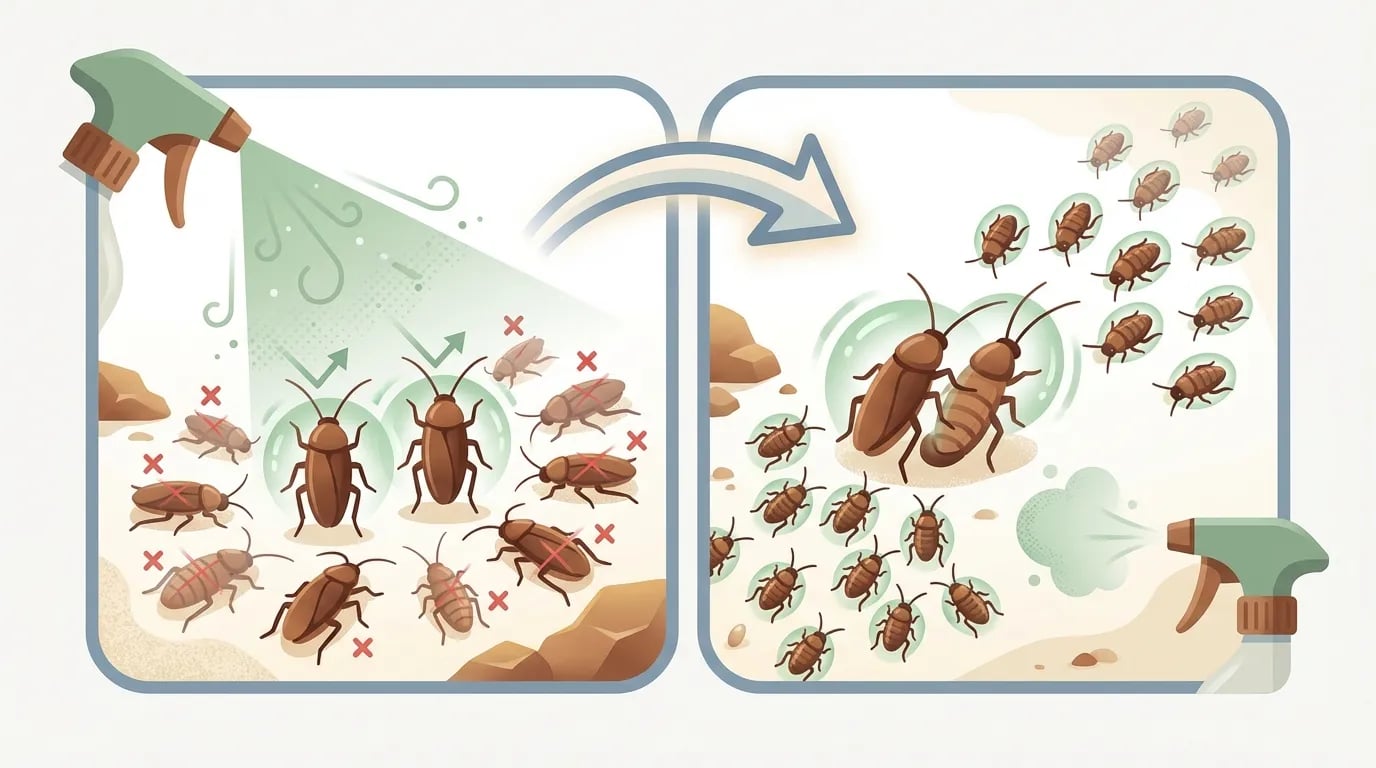
It's important to understand one thing: insects don't become resistant during their lifetime. A cockroach doesn't "train" its body to tolerate poison the way we lift weights to become stronger. It all comes down to genetics and natural selection.
In every large group of insects, there is a small percentage of individuals born with a natural, random mutation. This mutation may make their chitin shell thicker (the poison can't penetrate) or cause their body to produce an enzyme that breaks down the poison before it kills them. When you spray, 99% of the "normal" insects die. But that 1% with the mutation survives. These survivors reproduce among themselves. Their offspring inherit the protection. After several generations, the entire colony in your home now consists only of descendants of those "super-insects." And the old product is now useless.
Causes and Human Mistakes
Resistance is a natural process, but human mistakes accelerate it dramatically. When we use biocides (pest control products) incorrectly, we literally help insects evolve faster.
Here are the most common mistakes:
- Repeating the same product: This is the classic scenario. If you use the same active agent for years, you create enormous "selection pressure." You kill the weak and leave only the resistant ones.
- Incorrect dosing (sublethal doses): Many people, trying to save money or out of fear for their pets, dilute products more than indicated or spray too sparingly. This is the worst thing you can do. It doesn't kill the pest but only makes it slightly "sick," giving its body the opportunity to learn how to deal with the toxin.
- Lack of "follow-through": A single spraying is rarely enough. If you kill the adults but the eggs hatch a week later and you don't spray again, the new population will encounter the remnants of the old product (which is already weakened) and will begin to develop resistance.
Mixed Resistance (Cross-Resistance)
This is where things get even more complicated. Consumers often say: "I changed the spray brand, bought 'Killer 2000' instead of 'Super Exterminator,' but it still doesn't work!"
The problem is that trade names number in the thousands, but the groups of active substances are few. Most mass-market products (especially aerosols) are based on pyrethroids (cypermethrin, permethrin, tetramethrin, etc.).
If a cockroach population develops resistance to cypermethrin, it very often automatically becomes resistant to other substances from the same chemical group (e.g., permethrin), because the mechanism of action of the poison is the same - they attack the nervous system in a similar way. This is called cross-resistance.
Even worse is the variant of multiple (mixed) resistance. In this case, insects develop several different defense mechanisms simultaneously - for example, a thicker shell (reduced penetration) plus hyperactive enzymes (rapid breakdown). Such insects are extremely difficult to destroy, even with professional products.
Reversible and Irreversible Resistance
Is there good news? Somewhat. Resistance can be of two types:
- Reversible (unstable): Often maintaining defense mechanisms is "expensive" for the insect's body. Resistant cockroaches may be smaller, live shorter lives, or lay fewer eggs compared to normal ones. If you stop using the given product for a long period (for example, a year), the "normal" genes may once again prevail in the population because those individuals reproduce faster in the absence of poison. Then the product may work again.
- Irreversible (stable): With long-term and intensive use of the same chemical, resistance becomes so deeply embedded in the population's genome that it becomes a permanent characteristic. Even if you stop spraying for 10 years, the population retains the memory of the poison and doesn't react upon renewed contact. This is the "nightmare scenario" for pest control specialists.
Methods for Reducing Resistance
The battle is not lost if it's fought with intelligence, not just force. Here are the main strategies that science and professionals use:
- Rotation of active substances: This is the golden rule. You shouldn't just change the brand, but the chemical group. If today you sprayed with a pyrethroid, next time you should use a product from the neonicotinoid, organophosphate (where permitted), or carbamate group. This way, different vital systems of the insect are attacked and it cannot adapt.
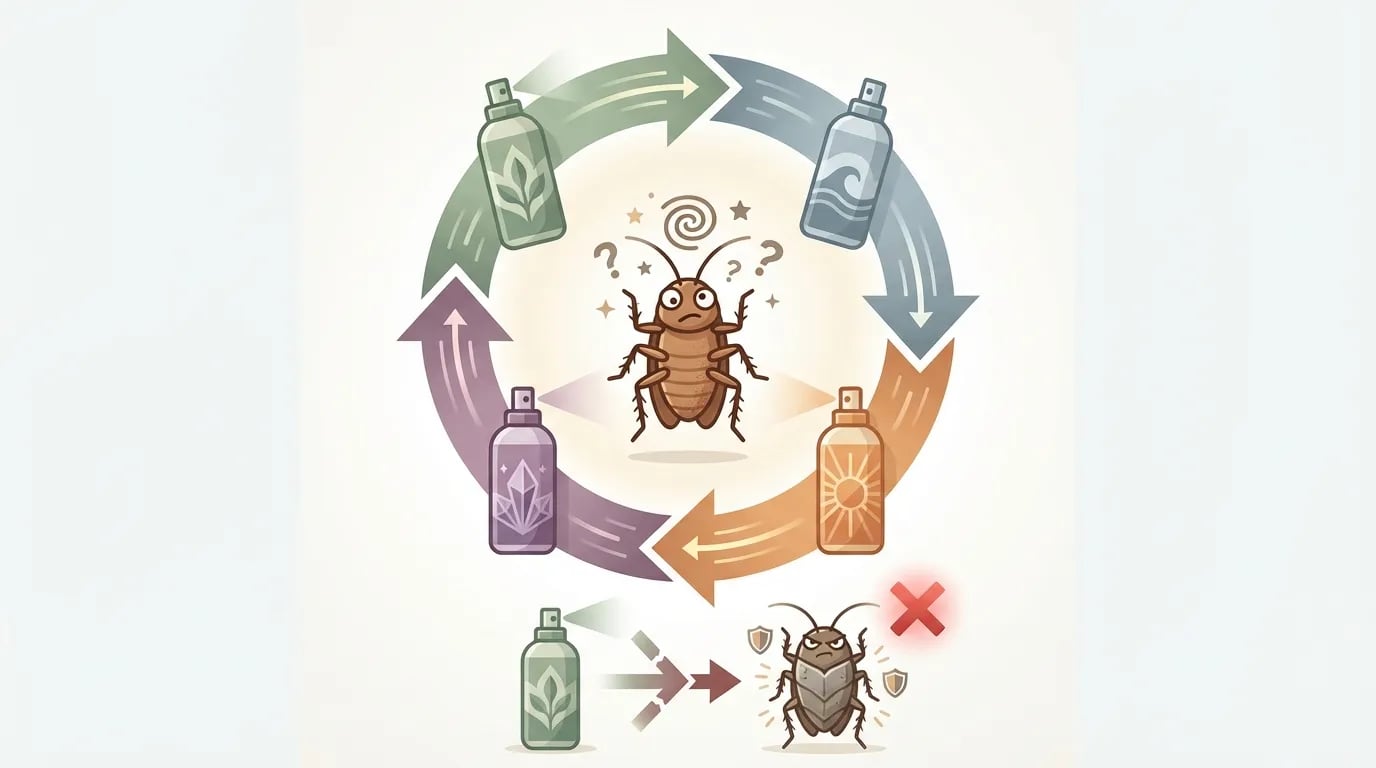
- Use of synergists: These are substances (such as piperonyl butoxide - PBO) that don't kill insects by themselves but block their defensive enzymes. When you add a synergist to the poison, you "disable the shields" of the cockroach and the poison can do its job.
- Integrated Pest Management (IPM): This is the modern approach. It doesn't rely solely on chemistry. It includes sealing holes, removing food and water sources, using traps and mechanical methods. When you reduce the comfort of pests, they become weaker and more susceptible to products.
The Search for New Active Substances
Unfortunately, developing new molecules is a slow and expensive process. European biocide regulations are extremely strict (and rightly so) in order to protect human health and the environment. Many old and effective but highly toxic substances have been banned.
Pharmaceutical and chemical giants can barely keep up with the speed at which pests evolve. The current trend is directed toward:
- IGRs (Insect Growth Regulators): These are "hormonal" products that don't kill immediately but prevent larvae from growing or make adults sterile. Resistance to them develops much more slowly.
- Biological agents: The use of fungi or bacteria that specifically sicken pests.
Conclusion: Why Trust Professionals?
Having read all of this, you probably realize that simply spraying with a canister from the store is like playing roulette. Often, by trying to handle things ourselves, we only "vaccinate" the pest population in our home, making it stronger.
Professional pest control companies (DDD companies) have several key advantages:
- Access to professional products: They work with concentrations and substances that are not freely available in retail. Many of them contain microencapsulated formulas (which release the poison slowly and over a long period) or powerful combinations of active substances and synergists.
- Knowledge of rotation: A good pest control specialist knows what was sprayed before and what should be used now to avoid cross-resistance.
- Strategy, not just spraying: The professional will find the nests. They know that bed bugs require one approach, while cockroaches require a completely different one (for example, using gel bait points that work on the principle of the "Trojan Horse" - one cockroach eats it, goes to the nest, dies, and the others eat it and also die).
The problem of resistance is real and growing. Pests are among the most resilient creatures on the planet, having survived millions of years. To defeat them in our own homes, it's not enough to simply spray more poison - we need to be smarter than them. And sometimes the smartest decision is to leave this war in the hands of specialists.
Pest Control Manager at "Biogard" EOOD
Iliyan Dimitrov is the Head of Pest Control (DDD) at Biogard Ltd. He leads disinsection, deratisation and disinfection operations for clients across the Ruse, Razgrad, Targovishte and Silistra regions.
All articles by the author